Molotschna women’s assembly
Women TalkingThe Molotschna women’s assembly is the collective forum in which women of the Molotschna Colony answer a crisis of male authority, religious discipline, and safety by deciding to leave. Faced with the expected return of imprisoned attackers and a demand that they forgive them or leave the colony, the women make departure an act of shared religious judgment and organize the means to carry it out.
Crisis and Constrained Choices
The assembly meets under an immediate deadline. The colony’s remaining men have gone to the city to post bail for the imprisoned attackers, hoping the men can return to Molotschna while awaiting trial. Peters presents the women with a further condition: if the attackers return, forgiveness will secure everyone’s place in heaven; if the women refuse, they will have to leave for an outside world they know nothing about. They have only two days to decide how to respond.
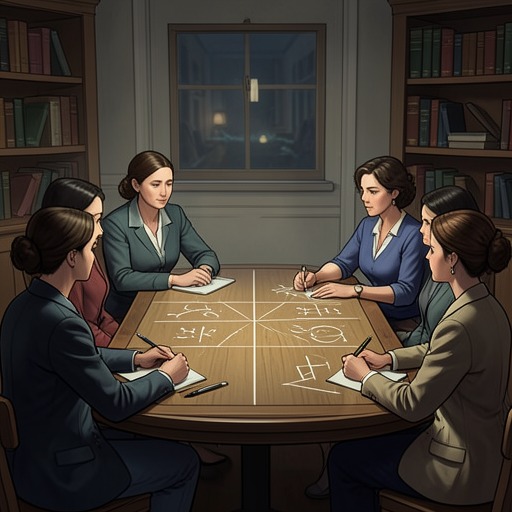
The women consider three options: doing nothing, staying and fighting, or leaving. The possibility of staying and fighting is formally put on the agenda, but the deliberation does not treat the choices as equally viable. When the case for leaving is assessed, Salome Friesen says there are no disadvantages to it. The decision emerges within an imposed threat of displacement, yet it is also framed by the women as their own collective choice rather than as compliance with the men’s demand.
Faith, Nonviolence, and Interpretation
Agata Friesen argues that remaining would place the women in the path of further violence and risk turning Molotschna into a battlefield. In her reasoning, staying could mean betraying the Mennonite commitment to pacifism and compromising the women’s ability to offer love and forgiveness freely. If they stayed in conflict with their attackers, any forgiveness might be coerced rather than genuine. Leaving, she contends, would better enable them to practice nonviolence and teach those values to their children, beyond the expectations imposed by the children’s fathers.
The debate also concerns who has the authority to define religious obedience. Salome Friesen observes that the women cannot read the Bible and that their understanding of a duty to submit to their husbands comes from what their husbands have told them the Bible requires. The assembly’s deliberation therefore does more than choose a destination: it subjects inherited claims about submission to examination by the women themselves. Agata Friesen describes their decision as a convergence of maternal instinct, intellect, and faith, and urges them to trust the change they have interpreted as God’s will and a responsibility to their children and to one another.
From Deliberation to Decision
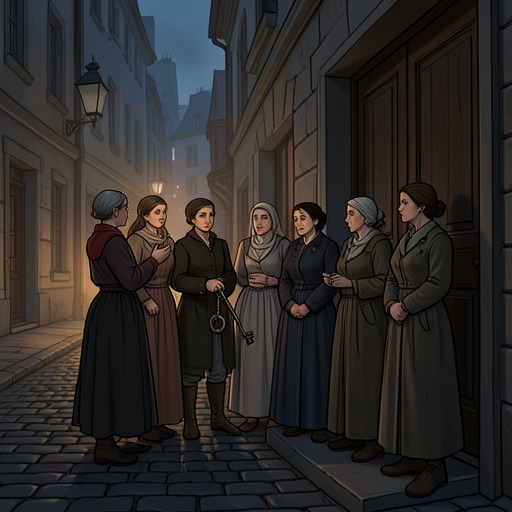
The meeting’s pace shifts as the deadline approaches. Agata Friesen distinguishes the previous day, devoted to talking, from the present day, which must be given to action. She asks whether the women have, more or less, rejected staying and fighting in favor of leaving because they are pacifists. Later, the assembly settles on departing after dark, so that the women will not be seen while passing the Chortiza Colony and Hiakjeke Colony.
The planned departure depends on coordination, transport, and supplies. August Epp reports that he has obtained the co-op safe, a stick of dynamite, and a world map. He has concealed the map by wrapping it around a large block of cheese and covering it in ordinary brown paper. The safe is placed beneath the back seat of Greta Loewen’s buggy. He has also packed onions, soap, and pieces of wood to provide traction if wheels become stuck in mud or to serve as kindling. These provisions make the assembly’s resolution materially specific without removing the uncertainty of travel into a world the women have been told they do not know.
Surveillance and Collective Logistics
The departure plan faces possible interception. Agata Friesen says the Koop brothers are waiting for the women to make their move so that they can inform the men in the city, or perhaps stop the women from leaving themselves. Their claim that there is a fire north of Molotschna is described as a tactic intended to push the women south, toward the city and the men there. The assembly must therefore account not only for the route but also for the possibility that information and movement will be controlled by others.
Agata Friesen arranges for Melvin to keep the children occupied with a game and to watch the cow path along the field, where the women will meet them as they leave Molotschna. She anticipates at least ten buggies and ten teams. The child-care arrangement and the watch on the path are parts of the same operation: the women’s movement depends on bringing children into the plan and coordinating the meeting point with their departure.
Significance and Limits of the Plan
The assembly brings religious argument and practical organization into one process. Its members do not reject faith as a reason to act; they dispute interpretations used to enforce obedience and argue that leaving may better preserve pacifism, forgiveness, and responsibility for children. The map, food, soap, safe, transport, and concealed route give that interpretation a material form.
The evidence establishes the decision and its preparations, not the completed outcome of the journey. The assembly is poised to leave after dark while the men are expected to return, with the risk of being seen or intercepted still unresolved. Its significance lies in the women’s collective movement from imposed alternatives and urgent discussion to a coordinated plan they understand as both an act of care and a practice of faith.